- Nick will wrestle control of the Facebook away from Patrick Emerson
- Vivian will look into having a presentation on graduate school next week if there is enough interest.
- Everyone will work on developing a library for the econ lab. Jesus/Joe will work on cleaning the shelf in the break room and eventually move it into the econ lab
- Jesus will send out an email about upcoming seminars
- Josh will work on keeping track of econ alumni
- Jesus will run meetings more professionally
- Mervin is taking minutes at meetings
- Mervin will also evaluate whether Facebook or Blackboard is a better medium for the Club's communication
- Nick will hassle Mai to start going to the Econ Club again
- Pratchet is writing a rebuttal to the gender discrimination post that was posted on the barometer earlier this week
Friday, May 25, 2012
Econ Club Minutes - May 25th
The Econ Club is progressing according to a plan. Here are the tasks that we decided on at the last meeting:

The gender wage gap not based on discrimination - The Daily Barometer
The gender wage gap not based on discrimination - The Daily Barometer
So this article was brought up at the last econ club meeting, and some of the members thought it would be interesting to write a rebuttal to this. Also, we may be able to convince the author of the article to go to the econ club next meeting.
Monday, January 30, 2012
Club Meeting on Feb 3rd
We're meeting this Friday, Feb 3rd 5pm @ McMenamins. Joining us this week is Professor Schroeder.
Monday, January 23, 2012
Is it the same? Also econ club at the bottom
Are these two scenarios the same?
A) You work and earn 50 dollars. You spend that money to buy socks, and you're given a fifty dollar toy that enriches your life.
B) You work and earn 50 dollars. You spend that money on a toy that enriches your life, and you're given a gift of 50 dollars worth of socks.
I had an argument with Professor Stone on this. Rationally, these two outcomes are the same; in both you end up with 50 dollars in stocks and 50 dollars in toys. However, I argue that, for homo sapiens instead of homo economicus, the scenarios are not the same. One is clearly better for you than the other.
As econ students, we're taught that people convert their leisure into work, and through that work they receive an income which they then convert to goods and services. Because of this idea, I believe it matters to people how they spend their money versus what they receive as gifts. Especially if your job is demeaning and life has lost its purpose and joy, buying necessities using your income is doubly defeating. You are giving up a part of your life to buy things to sustain a life already joyless. The only thing that keeps you going is an endowment of something enriching like a toy at Christmas. This is the world of scenario A.
Although the material outcome of scenario B is the same, the story and the agent's satisfaction with life are different. The same demeaning work is not used to perpetuate a dreary life. Instead the work goes towards a good which the agent genuinely values. The necessities to continue living are taken care of by a gift.
Not only are the scenarios different, I would argue that B is preferable to A. At this time in many of our lives as college students with low income jobs, I claim that we should be grateful for gifts of socks and tooth paste and other necessities so that it frees up our income to buy things that will be meaningful to our lives. Work is so much more palatable a sacrifice when I think that it's going towards an opera ticket versus next month's gas & electric bill.
So are these scenarios the same to you? Or would you prefer to receive gifts of luxury while converting your work into necessities? Or am I overthinking this whole thing because I've been spending too much time in economics?
Econ club will be meeting this Thursday, Jan 26th with Professor Stone at 5pm upstairs in McMenamins.
Monday, November 28, 2011
For real this time: Club meeting with Prof. McGough!
Econ club is meeting at our standard time, this Thursday (Dec 1st) at 5pm upstairs at the Monroe McMenamins. Professor McGough should be joining us unless he decides again that his kids are more worthwhile.
Thursday, November 3, 2011
Club Meeting with Professor Bruce McGough
Professor Bruce McGough, the Department's macroeconomist and boogeyman, will be joining Econ Club on Thursday Nov 10, at 5pm at McMenamins. As usual, we will be meeting upstairs. Come for entertaining and raucous discussion!
Wednesday, October 26, 2011
CORRECTION! Change in Meeting Place and Time
Tomorrow's meeting will start @ 4:30pm in McMenamins on Monroe.
Sunday, October 23, 2011
Meeting on Thursday Oct 27 5pm @ Bombs
The Econ Club will be meeting this Thursday 5pm Oct 27 at Bombs Away Cafe. Our guest this week will be Professor Todd Pugatch, the department's newest faculty. Stop by and share drinks and food with your fellow econ majors while we slowly try to figure out the future of the club!
Tuesday, April 5, 2011
An Econ Club Meeting
Tomorrow, April 6th, the Econ club will be meeting with Professor Dan Stone at McMenamins at 5:45pm, after Behavioral Econ class. This blog post makes it official!
Tuesday, January 4, 2011
Tutors! Tutors!
Hey just in case you come to this website for actual news instead of blatherings, I'm proud to announce that the Department of Economics will still have regular tutoring during Winter 2011!
Tutors will be available from 11am-4:30pm at the Economics Undergraduate Lab on the third floor of Ballard Extension Hall. We're at the north end of the long hallway, and we can help you with ECON 201 and 202, principles of microeconomics and macroeconomics. We also have computers at the lab if you need help with blackboard or other internet material.
Comic books and misplaced incentives
I've started reading a new comic book called Chew, mostly because the main character is Asian, and how often does that happen? Chew is about detective Tony Chu, a cibopath. When he eats something, animal, vegetable, or mineral, he gets visions of the dead meal's life. This becomes useful when he's recruited by the FDA to be a lead investigator. In the world of Chew, the FDA is the largest and most powerful law enforcement agency in America. After avian bird flu turned out to be a dangerous plague killing millions of Americans, the FDA declared a prohibition on chicken, and became a tyrannical secret police force.
Though of course this comic book is a humorous exaggeration of real life, it does touch upon a weird problem government agencies have. The FDA both advises food and drug laws and enforces those laws passed by our legislatures. This gives the FDA incentive to push for laws that increase enforcement levels and argue against laws that require less enforcement. The FDA wants to survive, so obviously it may have incentive to tell a story more grim than may be true.
If this is sounding a bit like mad conspiracy talk, I'll try to respond with that I don't think the amount this conflict of interest causes poor governance is necessarily high. I have no proof of that. I do think though that most economically-educated people would agree that having an agency both in charge of advising policy and enforcing policy creates an unwanted incentive for the agency to overpromote enforcement.
Wednesday, December 8, 2010
Poor Economics at OSU's Library
I don't buy text books anymore. Whenever I think about buying a $300 text book I won't ever read except when it's eight hours before an exam, I imagine instead of buying a mountain of $1 Jr. Bacon Cheesburgers, a much better investment if you ask me.
So I'm forced to use course reserves at Valley library. It's normally a good system except that its late charges are horribly underpriced. A buck an hour? That's ridiculous! Find me this prat whose been holding on to "Public and Private Families" for the last four hours and I will pay him oodles of cash to have this book now so I can study and go to sleep at a reasonable hour.
Valley Library needs to realize that this price is resulting in market inefficiency. Certainly the damage of this jerk holding onto the book beyond the due date is causing me more than a dollar's worth of damage. I wonder how successful a floating overdue fee would work out. I may use this excess waiting time to draft just that kind of model.
Wednesday, August 11, 2010
Credible Threats and Murdering Children
While looking at my loan repayment plan today, I started thinking about the fairy tale of the Pied Piper.
For anyone who isn't familiar with the story, back once upon a time there was a town infested with rats. The townpeople hired an expert rat-catcher to lure the vermin out of town with his magic flute. The rat-catcher did his job, but when it came time for the town to pay him, they reneged on their payment. To retaliate, the Pied Piper came back, and used his flute to lure the children of the town away and into a cave, and one can only assume he ate them all.
The moral of the story is if you don't pay the man, he'll come and take your babies from you. The fault is almost always placed on the greedy, cheating villagers and rarely on the child-killing psychopath, but my inner economists sometimes wants to side with the town.
First, let's take this incident in isolation. Granted, defaulting on promised payments can have deleterious effects on long term growth (just ask any country that's had problems repaying loans), the town could have assumed that it would be a long time before they would have another rat problem, long enough that their bad credit history with rat-catchers would have been buried with age. That's not so hard to believe, as credit agencies back in once upon a time were probably rubbish at bookkeeping, and professionals would have been starved for work anyway.
Second, no one could have predicted that the duped rat-catcher would make good on his threats. It doesn't make rational, economic sense! In game theory we learn to analyze if threats are credible. In this case, the Piper threatens to kill the town's children if he isn't paid, and that's a textbook example of a non-credible threat. If the town doesn't pay, then the Piper is left with two options: kill the kids or don't. Neither of those options will get him his money back, so at that point he would have no reason to kill the kids. Really if he were a better hostile negotiator, he would have threaten to just kidnap the kids and hold them ransom. That is a much more credible threat, and would probably have gotten him paid in the first place.
Instead the Pied Piper makes an non-credible threat, and the town rightfully called his bluff. I fully support their decision; it was just unfortunate that the Pied Piper turned out to be an irrational, child-murdering agent. Economically, the town's logic was sound, but I'll be repaying my student loans in case my creditors turn out to be as irrationally homicidal as the Pied Piper.
Sunday, July 25, 2010
Look at me, I'm reading The Economist! How reading The Economist is like drinking Indonesian cat poop coffee.

I only read three publications regularly: The Daily Barometer for its raunchy forums section, The Jakarta Post for news from Old Country, and The Economist because, as one Vanity Fair writer put it, it's "like that exotic coffee that comes from beans that have been eaten and shat out undigested by an Indonesian civet cat."
The Economist has an undeniable snob appeal, and I admit that's probably at least 50% of the reason I subscribe. One immediate indicator is its price, which has been consistently more expansive than Newsweek or Times, even after both American magazines had to update their prices due to reduced circulation. Another plus for The Economist is that its character is ostensibly that of a worldly, cynical quantitative social scientist. The magazine takes a center-right position, advocating economic liberalism, but also sensible government intervention where appropriate. These folks aren't your typical gun totting teabaggers, but you won't see them at a WTO protest either.
Lastly, The Economist insists upon itself with its cheeky petulance. Though obviously a magazine, it demands to be called a newspaper. Bylines are dropped, opting for an idea of a single, unified voice. The humor used is like an inside joke between readers and the writer. It's that kind of subtle, sarcastic wit that makes you smile smugly and go, "Heh." I bet you were beaten up a lot on the playground, too, nerd.
But while the smug appeal of The Economist might justify a slight premium, its content also excuses its price. My favorite sections of The Economist are actually its smaller articles, the ones that focus on events too local to make headlines. One article was about a woman in Washington who started a grassroots campaign to stop eminent domain, but was obstructed by bureaucratic regulations of political activism. The Economist writers often look at these minute events and interpret them from its consistent position of economism. The Economist is like that kid in your class who insists on talking about hair products from the perspective of microeconomics. You'll either hate it, or spend $120 on a yearly subscription.
Wednesday, June 30, 2010
Whoa, a thing is happening!
If you're in Portland from now until July 3rd, the 85th annual conference of the Western Economic Association International is meeting to talk econ things and do econ stuff, which I think means drinking, a great tradition I'm proud our econ club follows. The registration fee is outrageous, but someone in our department told us you can sneak in real easy. It'll be like jumping the fence at Coachella, except a lot less cool.
The real draw is that on Friday, July 2nd, our very own Patrick Emerson will be organizing and chairing a session on Issues in Growth and Development. Other celebrity panelists include Bruce McGough and Elizabeth Schroeder, who will be teaching at Oregon State starting in the Fall. Other OSU professors and grad students will also be presenting papers at the conference, so click here for more information about the conference.
Sunday, June 13, 2010
June is John Maynard Keynes Month
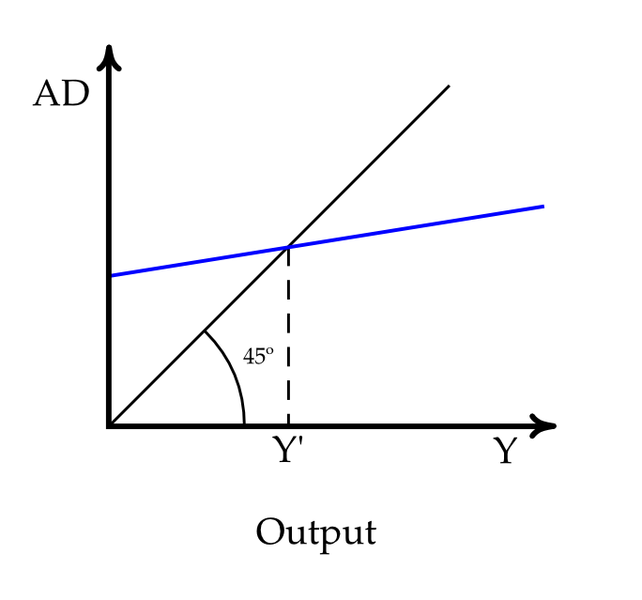
June 5th is the birthday of both John Maynard Keynes and Adam Smith. What an auspicious day to be an economist!
Keynes, a Depression-era macroeconomist, has come back into popular (popular for an economist) focus after this most recent economic crisis. His solution to depressed markets could be grossly simplified as fiscal expansion. If governments spend more, total output will increase.
In fact, looking at the Keynesian Cross model, even a modest increase in aggregate demand will lead to a much larger boost in output. The story is delightfully simple. Imagine today the government gives you 10 bucks to build a dam. You take that 10 bucks, save maybe 2 dollars, and spend the other 8 on Carls Jr. Carl then takes your 8, saves a dollar from it, and spends the other 7 buying more beef. The rancher saves a bit, spends the rest on fertilizer, and so on and so on. We see that from that initial 10 dollars, the money goes a long way in generating transactions.
Of course we learn this the first week of Intermediate Macroeconomics I. Week two, with its IS-LM and A Sad World models, shows us why this doesn't work and why we should all be good little monetarists. Still, enjoy your time in the sun, Mr. Keynes! June is your month!
Last thing I want to share, hip hop artist Slim Thug giving props to Sir John. Skip to 1:40 for the coolest moment macroeconomics will ever have.
| The Daily Show With Jon Stewart | Mon - Thurs 11p / 10c | |||
| Slim Thug's Music Video - Still a Boss | ||||
| ||||
Wednesday, June 2, 2010
Seminar! Seminar!
Our very own Zheng Cao and Daniel Stone will be presenting a paper on choking under pressure in the NBA this Friday, 1pm in Kelley 1001. You're all welcome to come and show support and pretend you understand economics for a while until the speakers get to the punchy conclusion. Afterwards we may have an econ club meeting to elect the new president, or I'll just assume power.
Tuesday, May 25, 2010
Thinking about Grad School? Me neither!
But in case you decide 3 more years of sadness is in your future, an anonymous senior level cabinet official professor from the department linked me to this page full of advice on applying to grad school.
My favorite tidbit is: "Get to know some professors well. Professors will be very excited that you want to get a Ph.D. in economics. Don't be afraid to approach them. Listen to their advice."
In other words, come to the econ club meetings more often! Get to know the professors better, gamble on whether they'll pay for the food, and banter nonsensically about things tangentially related to economics!
Tuesday, May 4, 2010
That's the beauty of it - it doesn't do anything!
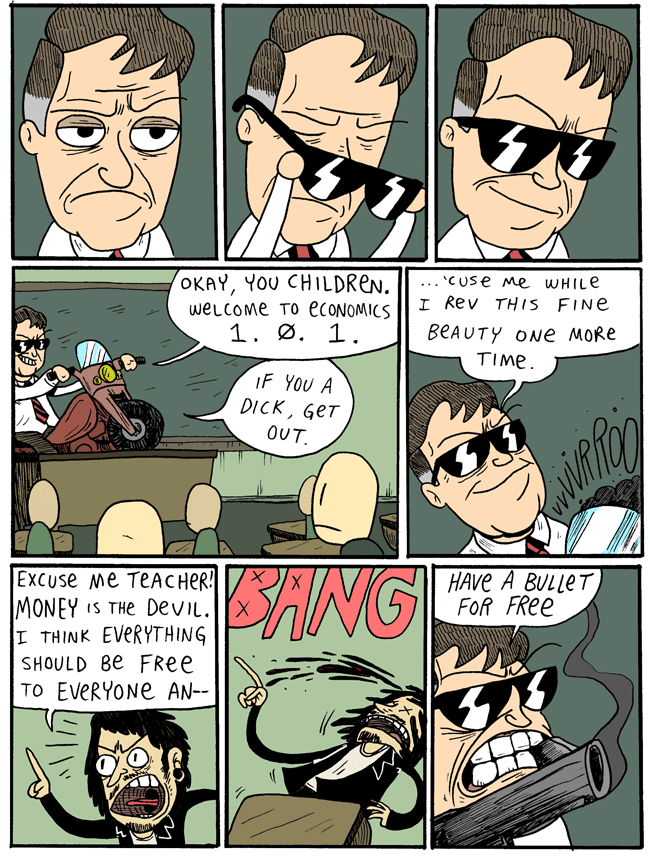
Lately some econ buddies and I have discovered that we really don't know how to define exactly what economics is. You know when you're in an econ class, but why exactly is uncertain. Vaguely it has something to do with limited supply and infinite demand. The solution is always where marginal benefit equals marginal cost. There damn well better be some calculus in it at some point.
So we have a laundry list of "You know you're in an econ class when..." but no real answer as to what economics is. My peers have been offering me some really neat explanations, but I prefer to pound economics into two realizations:
1. Economics is life sans bullshit.
Every important facet of human life will eventually be studied by an economist, and they will strip it down to its integral parts. While most people have some misguided notion that econ students study the stock market all day, anyone who has sat through Prof. Grosskopf's efficiency class and has listened to students' research proposal knows that economics studies everything imaginable. Some people are studying airports. I'm looking at tobacco ads. A bunch of guys are doing baseball. People who have never opened an econ journal or read Freakonomics might be puzzled to see the scope economists encompass. Economics is varied and everywhere.
More importantly, economics does away with the bullshit that accrues when other fields study issues. Sit in on a business class and listen to them talk about value. For them, value = quality / price. What is quality? Personal value to customer. How is that different from the value on the left side of the equation? Hell if I know, because to an economist, value = price you're willing to pay. Bam. Simple.
Here's another example. Ask a person what goes into their decision to buy goods. They might go on all day about why this product is good, why this one's a bargain, why these ones are crap, why they're addicted this those, etc etc. To an economist, it's just Dx(Px, Py, I) Booya, a demand function.
Economics takes a subject and does away with the frills, gimmicks, and buzzwords. What's left is what's essential. There is a methodical, mathematical cleanliness to economics that you just won't get from other social sciences or business disciplines. If there is a relentless difficulty to economics, it's because you cannot escape it with bullshit.
Which leads me to my second conclusion:
2. The World operates on bullshit.
My econ degree makes me feel helpless and frustrated. Economists know the answer. Fiscal policy is ineffective in the medium run. Externalities can be solved with the Coase solution. Businesses should operate until marginal cost equals marginal benefit. There are no profits in the long run.
So why the hell do I find myself arguing with the newspaper every morning? Why are politicians doing silly things, and why can't I get a job after graduating? I can only conclude that this is because the world actually operates on bullshit. All the useless variables I've spent my education learning to assume away is actually the most important part of the function.
It turns out, kiddos, that you won't be paid the marginal product of your labor; it's who you know. Politicians will whimsically order some parts of your life and not others. Businesses actually want you to use buzzwords. You will not need calculus.
It's a rather cynical conclusion. Studying econ has told me that economics is right, but ignored and possibly useless. We come after the fact, so some other discipline will come up with a new idea, and economists can explain why is succeeded or failed. Getting people to listen to our own ideas, or maybe even just coming up with original ideas on our own, is a harder, meaner feat.
I'm hoping to be proved wrong, though, and I heard someone in our department recently got an internship with the Fed, so there might be hope yet. Also they keep telling me that economics majors make money after college, so maybe there is a demand for less bullshit.
May is Karl Marx Month

Cinco de Mayo, more than just a Mexican holiday, is also the birthday of Karl Marx, notorious political economist and Evil Santa Look-a-like. When I was in the 10th grade, we had to read the Communist Manifesto for an English class. At the time, I was also working in retail and a member of a union, UFCW Local Chapter 555, so it was an exciting time to be a budding communist.
Then I took 11th grade Economics and promptly forgot about class struggles and command economies. Looking back, I wonder how communist economics would be taught in a true econ class using models and mathematics instead of just rhetoric. It's too bad Oregon State doesn't offer a course on heterodoxical economic models.
May is an important month for working people. May 1st is International Workers' Day, when unions and left-wing political groups take to the streets and protest for better living standards for the working class. Even though May Day started in Chicago, it has lost popularity. in America. Labor demonstrations remain very aggressive in the rest of the world, with protests turning violent in cities such as Athens, Macau, and Berlin.
Karl's grim specter of Communism hasn't completely left the world even after the end of the USSR. Workers around the world have yet to buy into free market liberalism and remain skeptical of its promises. Although I haven't been an active member of my union in years, I'm going to make an effort to wear red this month to show at least superficial camaraderie for my working brothers and sisters.
Subscribe to:
Posts (Atom)
